 Team Winging It
How we built Kanat.
Two weeks, one brief, and a lot of ideas we had to kill. What we read, what we dropped, and what a mentor told us that changed everything.

Our thesis, before we saw the brief
AI personal assistants look set to win on planning and discovery, and they want the booking too. What they cannot see is the airline's live supplier data: real fares, real seats, real add-on prices. That is where an airline wins.
Every passenger arriving from an assistant brings their planning context. The airline should pick it up and propose something close to the best package right away.
The better the direct channel performs, the less reason a passenger has to book anywhere else.So the idea was a companion that sits beside the booking flow and uses data nobody else can see to remove the avoidable reasons people abandon a basket: the full price upfront, an answer to whether a connection is long enough with elderly grandparents, a steer toward flights with full rows free.
Pegasus's FAQ answered our scope questions. Assistant context is welcome as an input but a solution must not depend on it, so the final companion works with no context at all.
The brief, and more than a hundred ideas
The brief asks for an AI companion that guides passengers proactively while they book. It must not be a standard chatbot. It rules out:
- A chatbot, or a chatbot feature list.
- A standalone assistant cut off from the Pegasus app.
- Pure booking automation: an agent that just buys for you.
- Copying what Pegasus already has after booking and at the airport.
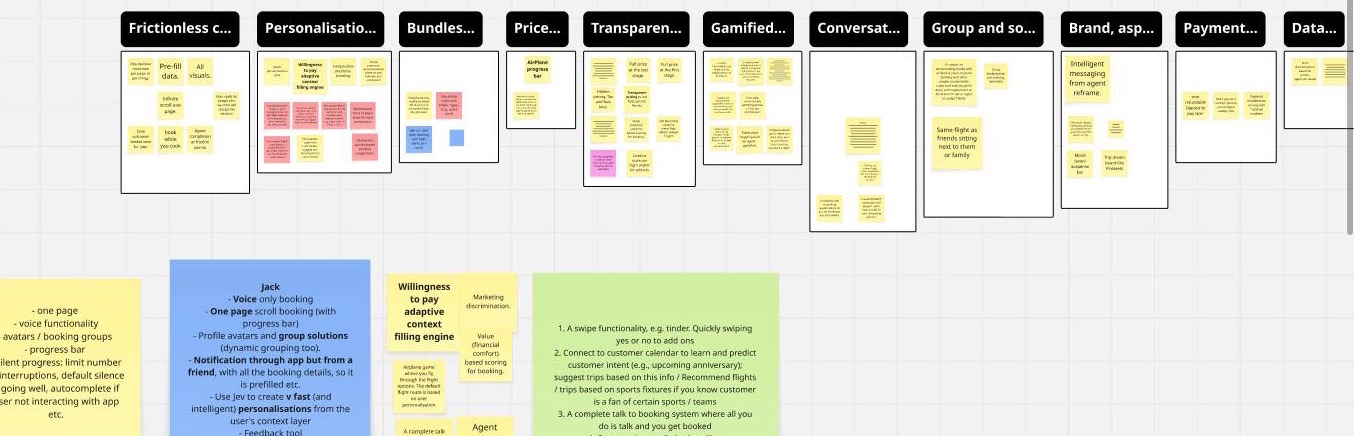
The team filled a Miro board with sticky notes, then kept going: rounds of our own until we had well over a hundred ideas. We held them against that list. Many failed outright. Others were dark patterns we did not want in a passenger's pocket: timed auctions, checkout races, "the price will rise" pushes.
Four survived and became the spine: an interruption budget with a one-line reason, traveller cards so advice changes per person, savings as "three nights in Istanbul," and seat advice for tight connections.
We walked the real Pegasus app
We went through the live booking flow screen by screen on one itinerary: Stansted to Ağrı, one adult, 389.13 GBP. Every number we quote came off a screen, and a test fails if a future screenshot disagrees.
The pattern: the app quantifies what it wants you to buy, and leaves vague what it costs you to choose differently, or to wait. The sharpest example is baggage. One route to a cabin bag and a checked bag is strictly better than the other three, and the app never says so.
| Route | Extra cost | Checked bag |
|---|---|---|
| Pick SAVER at package selection | 30.00 GBP | 25 kg |
| Stay on LIGHT, accept the upgrade offer | 59.00 GBP | 20 kg |
| LIGHT, add cabin bag and 20 kg (badged "Recommended") | 58.00 GBP | 20 kg |
| LIGHT, add cabin bag and 12 kg | 37.00 GBP | 12 kg |
The companion's job is to quantify the vague thing at the moment the choice is made.
The route the app recommends costs 28 GBP more for 5 kg less. The payment page also carries a 58-minute countdown, while the real question, whether to book now or wait, goes unanswered.We also found what not to claim. The app already stars the cheapest day, and already ships a "Pegasus Assistant." So we never lead with "a cheaper date exists" or "an assistant."
Three paths that taught us something
- Flight Quest. Booking as a flight, with a "captain" writing one plain sentence about who this traveller is on this trip. It taught us that the reason for a suggestion matters as much as the suggestion.
- Radical hospitality. A character built from Ritz-Carlton, Danny Meyer, Will Guidara and Turkish misafirperverlik. A service app asks what it can sell. A host asks who this person is.
- Where to. Say where you are going and the booking fills itself in. No reply bubbles, only receipts with an undo. This became the one input in the final app.
On 4 October we tried three looks for the same idea. The one that stuck opens having already decided. It pointed at the real answer: the companion should speak first.
"It isn't agentic enough."
A Pegasus mentor told us too little was happening proactively in the background. They set two bars: clearly agentic, not just a voice layer, and clearly distinct from a white-label tool.
That day the team agreed the scope everything after it answers to:
- The companion is the front end, the agents are the back end. The passenger meets one calm face and stays in control: suggestions, never automatic bookings.
- The intelligence layer is a commodity. What is not: live fares and seat maps, past trips, abandoned searches, and the feedback from every tap.
- Two stories, a backpacker group trip and a family birthday trip, each shown side by side as the old way and the agentic way.
Meet Kanat
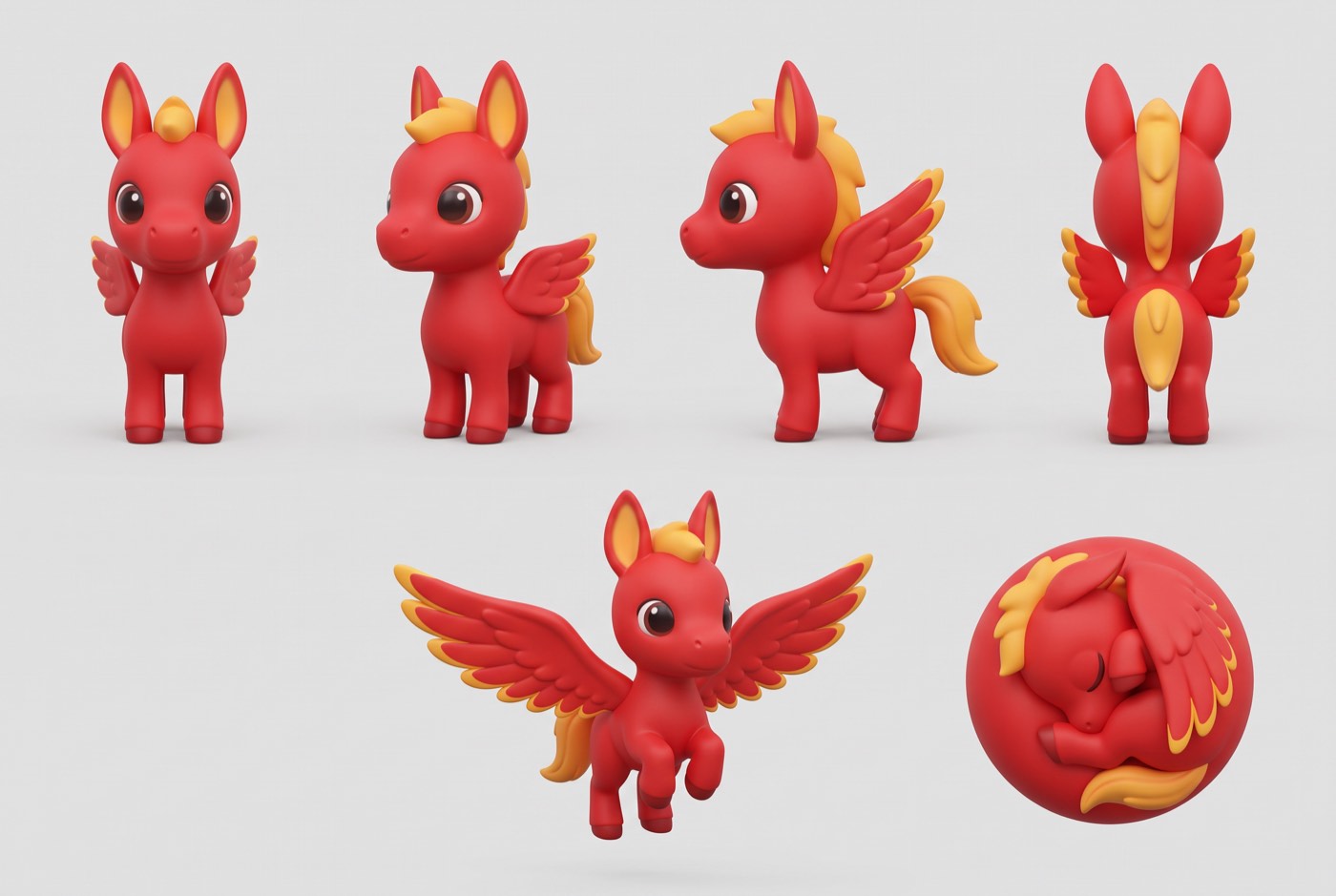
Kanat is Turkish for "wing." It is the face of the agents: a small red winged foal that never speaks. It chirps, flicks its wings, and brings you things. Every person gets their own Kanat, with one small accessory each.
The work happens backstage and you only see the result. In the film, every agentic action becomes an object Kanat carries in, so the ad reads with the sound off and never needs to show a phone.





We cut our first film. It was a bigger ensemble, two stories and twenty-four scenes, and far too long. The honest review was that the demo could not show most of it. We cut it back to one story, one trip, three friends. The seven beats of that story are at the top of the home page.
Building the demo, in the order it happened
The commit history reads as the thinking, because each change was made for a reason we wrote down.
- Start from the real thingA booking mock restyled against screenshots of the live app, with the real fare packages and baggage economics encoded before any feature.
- A chat-first mockup, then a ticketThe first assistant was chat-first. Within a day the trip printed as a ticket instead of a reply, and the transcript went away.
- Rebuilt after the feedbackRebuilt to the storyboards, with an Agent view that streams the agents' thinking live and a second phone for the other travellers.
- Stripped backCut screens and collapsed agent steps, and added the impact column: revenue, add-ons and new users against a stated model of today's app.
- One journeyThe red winged face went in, Will's nudge became a WhatsApp, and the whole app was cut to one story: three mates go to Cappadocia.
- Count the clicks"Bookings" became taps, the measure a passenger feels, counted screen by screen against a mock of the live journey.
Four agents, four guardrails
| Agent | What it does | What it moves |
|---|---|---|
| Trip | Spots a trip before anyone searches, then builds the itinerary. | More passengers |
| Offer | Predicts the extra each traveller will buy, and when to ask. | More per passenger |
| Group | Turns one booking into a group, seated together. | New direct customers |
| Moments | Picks the right moment and channel to speak. | Repeat booking |
- Pegasus sets every price.
- The passenger confirms every purchase.
- Silence is a feature. Ignored offers are not repeated, and "don't suggest again" holds for good.
- Every number is computed in code, never a model's guess.
What is real, and what is not
There is no AI model inside this mock. The sentence is understood by rules, and the reasons on the ticket are written in code. A real build puts a model behind the sentence and the reasons, and keeps everything else as it is: a model is never asked for a price, a date comparison or a seat, and it never speaks unprompted.